
D
o you want to buy a car directly from Japan? You can buy any used car from Japan’s car auctions at the same price local dealers pay. You only pay the auction hammer price (the final winning bid) plus our export service fee. There are no hidden markups. Our service is simple, honest, and fast. No tricky language. No surprise costs.
What Does “Direct Japan Auction Sourcing” Mean?
It means you buy like a real car dealer in Japan. You do not pay extra for a middleman who adds a big profit. Instead, you get the true auction price. This is the best way to get a high-quality used car at a low cost. Learn more about how we work →
1.
Where can I buy a used car at dealer price?
The best place is Japanese car auctions. These auctions are the biggest source of used cars with verified history. Every car comes with a detailed condition report. You can trust what you see.
2.
Who sells cars at these auctions?
Big Japanese car makers sell here. This includes Toyota, Honda, Nissan, Mazda, and Mitsubishi. These companies have dealer networks all over Japan. Dealers sell new cars to customers. But when a customer trades in an old car, the dealer sends that used car to auction. That is the main source of auction cars. So you are buying cars that originally came from official dealers.
3.
Who buys used cars from Japanese auctions?
Many buyers come to these auctions. Local shop owners and exporters buy here every day. Because many people are buying, the prices stay competitive. This means you pay a fair price — not too high. The auction price is set by real supply and demand.

4.
Are the cars sold in “as is” condition?
Yes. Almost all auction cars are sold “as is.” That means you will see the car exactly as it arrives. There is no washing or repair before sale. The buyer is responsible for cleaning, valeting, and fixing small cosmetic issues. This is normal. This is also why prices are low. You only pay for the car’s true condition.

5.
Where can I get a cheap but good quality used car?
More than 75% of all used cars sold in Japan go through auctions. For this reason, auctions are the favorite source for local dealers. If dealers trust auctions, you can trust them too. You get good quality at a low price. Request current auction stock →
6.
Understanding Stock at Japanese Auctions
Every auction has a stock list. This list shows how many cars are available each day. Auction networks like USS, TAA, CAA, and TC-WEB publish their stock online before the auction day.
Why stock matters to you:
- – More stock = better prices (supply vs. demand)
- – Low stock = hurry up — good cars sell fast
- – Some models appear only once a week. If you miss it, you wait
Exporters check stock daily. Now you can too. Get live auction access →
7.
What is “One-Price” or “STOCK” at Auctions?


Not all cars at auctions are sold by bidding.
Big auction networks like USS, TC-WEB, and JU-Navi offer a second option called “One-Price” or “STOCK”.
| Feature | Hammer Auction | One-Price / STOCK |
|---|---|---|
| Price | Goes up as people bid | Fixed price |
| Competition | Yes — you fight other buyers | No — first click, first buy |
| Speed | Wait for auction day | Buy any time |
| Risk | You might lose | You win instantly |
Real example from TC-WEB:Real example from TC-WEB (May 2026 – CAA Tokyo):
- Hammer auction: 3,289 cars per week
- One-Price: 8,297 cars
- STOCK: 124,557 cars
That means over 90% of available cars are fixed-price — no bidding!
Why do exporters hide this?
Exporters say fixed-price cars have problems:
- They may be unsold from previous auctions
- The same car may be listed on many websites
- The price may be higher than auction
But here is what exporters don’t tell you:
Live auction bidding is not a guarantee. You can lose. With fixed-price, you win instantly. No competition. No stress, and absolute time saving.
8.
What are Gulliver, JU Tentori, AS-Onepra, and Quick×Quick?
These are dealer networks connected to auction houses. They sell cars separately from the hammer auction.
| Network | What they sell |
|———|—————-|
| Gulliver | Japan’s largest used car dealer. Sells thousands of cars directly |
| JU Tentori | Dealer-to-dealer network. Good for wholesale prices |
| AS-Onepra | Maintained by largest market place and auction middle agency “Auto Server”. Good for wholesale prices |
| Quick×Quick | Fast sale program. Cars sell in 3 days or less |
These networks list their cars **inside the auction system** — but you do not bid. You see a price and buy. **Why exporters don’t tell you:** Fixed-price means lower profit for them. They prefer you to bid. [We help you buy from all networks →]
9.
Do big exporters like Be Forward, SBT, and Carused.jp buy from auctions?

Yes. This is a fact. Every major car exporter in Japan is a member of large auction groups. These groups include USS, TAA, CAA, JU, and Arai. Car dealers sell their cars at these auctions because they can move inventory faster than selling from their showrooms. So even the biggest exporters buy from the same auctions you can access. The only difference is that [we help you buy directly].
10.
What is the business model of websites like Goonet, Yahoo, Carsensor, and Nextstage?
These are private networks. They are not auctions themselves. Instead, they connect used car buyers with local shops. These shops often pay higher prices to get cars from private users. That means their prices can be higher than auction prices. For the best deal, auctions are still better
- Make more profit per car (if you are a dealer), or
- Pay less for your personal import (if you are an individual buyer).
11.
Are these private networks part of auctions?
Yes and no. Some networks like Apple, Gulliver, and Rabbit have connections to auction houses such as CAA, JU, and USS. If a person is on the director panel of an auction house, they must sell a certain number of cars at each auction. So auction management is indirectly connected to private users. But for you, the safest and cheapest way is still to bid directly at auction.
12.
How many cars are sold at each Japan auction?
Nearly 70% of all cars are sold at each auction. Why? Because prices are attractive. Also, the auction management supports sellers with a 60/40 ratio. Every car that enters a modern auction house receives a physical inspection. Inspectors check the exterior, bottom, and interior. The report is published on the auction page with clear photos. This allows online bidders to bid with confidence. The condition report is usually fair and unbiased.
13.
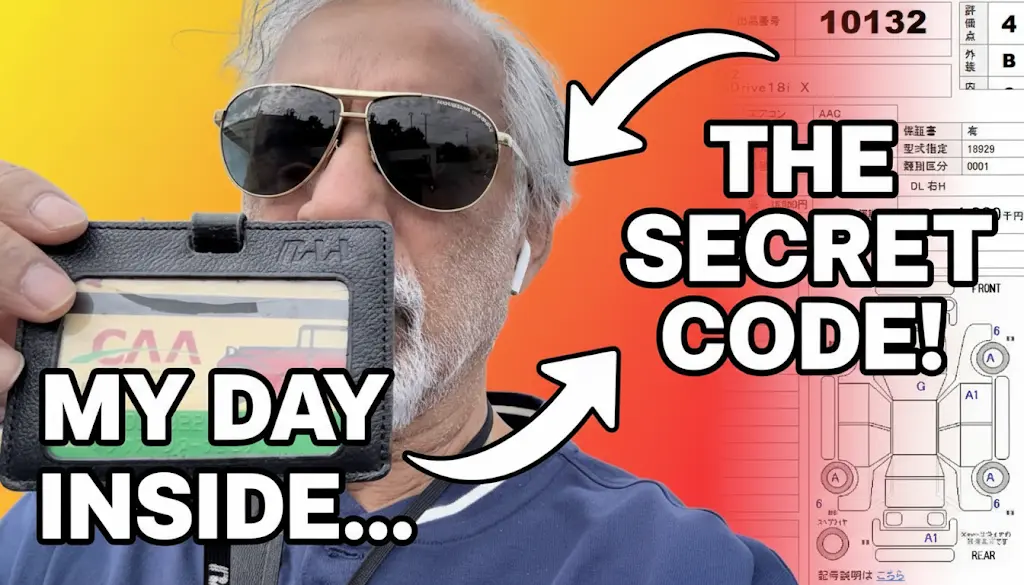
How much should I trust the auction condition report?
Most of the time, you can trust it. But human error is possible. Some inspectors may be more lenient than others. The auction house has a 1,000-page rule book for claims. This protects the inspector’s credibility. If a claim is easy to process, it is passed to the seller. However, in Japan, there is a saying: “Tono Shobai.” This means no absolute responsibility. So you must be careful.
14.

Should I ask someone to check the car, or is the auction sheet enough?
For most cars, the auction sheet is enough. But we recommend a private check for certain cases. These include:
– Cars with very high mileage
– Cars with a “Rent-A-Car” history (rental cars)
– Cars that may have hidden rust or poor repairs
A used car can have problems that the report misses. For example, more rust than written, hidden accident damage, or poor repair quality. A small private inspection can save you from a bad purchase. Contact us for inspection support →.
15.
What should I worry about most when buying from an auction?
Good question.
Here is the final list of things to think about:
– **Did I overpay?** Always check the market price before bidding
– **Rust problems:** Check the chassis lower arms, axle, and engine bay for rust
– **Sea-side use:** Was the car driven near the ocean? Salt can cause hidden rust
– **Bad smell or dirt:** Pet hairs, paw scratches, coffee stains, or cigarette smoke
– **Glass and lights:** Check the front glass and headlamps for cracks or cloudiness
When you are sitting thousands of miles away at your desk, you hope to get a “mint” car. But sometimes you get a “lemon” (a bad car). That is frustrating. That is why we suggest spending only $20–$30 for a private check — especially when you see auction grades like: **R, RA, 0, 2, 3, or 3.5.**
Most auctions are very strict for cars graded above 4. They want to protect their reputation. Always look at the interior grade as well:
– **A** = like new
– **B** = very clean
– **C** = normal
– **D** = dirty
– **E** = dirty with bad smell
16.
Buy with One Click — No Confusion
We know English is not your first language. Long forms are stressful. That is why we offer One-Click Purchase.
How it works:
1. We find a car you like from auction stock
2. You request “Buy Now” or “Bid for Me” via Whatsapp
3. We handle the auction purchasing
4. You win the car by bid or 1-click — we send invoice
5. You pay only hammer price + our service fee
No complicated paperwork. No hidden steps. No phone calls.
Is One-Click safe? Yes. We confirm every bid with you by message. You stay in control. Start your one-click purchase →.
Final Advice
Keep this guide as your pocketbook. It will help you make a smart, foolproof decision for your next purchase. Buying from a Japanese used car auction is a great way to save money. But you must understand the rules. With [our help](https://nexusscars.com/services) — and a little caution — you can buy a reliable, high-quality car directly from Japan at dealer prices.
What Japanese exporters don’t tell you: You don’t have to bid. You don’t have to compete. You can buy fixed-price cars from stock, use networks through our auction membership, and purchase with one click.


Ready to start? Contact us today Simple, honest, and fast.


